Why Do We Practice Yoga? Flat Belly!
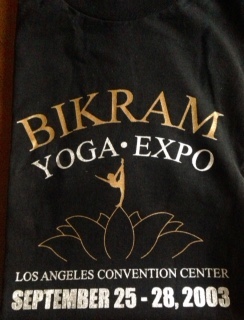
I gave a talk in 2003 at Bikram's one-time Yoga Expo: "Why Do We Practice Yoga, Firm Buttocks or Self Realization?" And I of course say "Yes" to both. In a recent article on MSN Health, "10 Reasons Your Belly Fat Isn't Going Away," I realized that I could now give a talk entitled "Why Do We Practice Yoga: Flat Belly!"
The list:
- Your sweat sessions don't involve sweat. (Make sure your cardio intensity is high enough that you sweat.)
- You're on a low-fat diet. (Add healthy plant-based fats such as olive oil or avocados.)
- You've been feeling blue for a while. (Depression is linked to poor eating habits and limited physical activity.)
- Your food comes from a box. (Carbohydrates can spike insulin levels.)
- You're skimping on the miracle mineral. (Eat foods rich in magnesium.)
- You're hooked on diet soda.
- You love burgers. (Eat more salmon.)
- You think girls don't get beer guts. (Wine or beer can cause belly fat.)
- Can't recall when you last said "Om." (See below.)
- Your meals are beige. (Eat a rich palette of color for a skinny midsection.)
This is a good list and worth your consideration. However, Sheila Dugan, MD suggested, "Not a fan of Sun Salutations? Take an hour to do something nice for yourself, which could help control your stress hormones."
I am suggesting that a regular hatha yoga practice can positively affect your belly fat and your mood. This online article went on to say, "Menopause-related hormonal changes make it harder to shed stomach pudge, but vigorous yoga can help offset the effects. A 2012 study found that postmenopausal women who did an hour-long yoga session three times a week for 16 weeks lost more than half an inch around their waists." Even though this study cited women, yoga for streamlining the torso applies to men as well.
I would say that it is not just sun salutations. It is rather the gentle squeezing and releasing action of the yoga postures that contributes to a flat belly. Various postures put a tourniquet on the muscle, organ, or gland. The release increases circulation. This is beneficial and allows the glands to release their hormones directly into our systems.
These five asanas are at the top of my list for reducing and utilizing the middle section of our body. Sitting at desks, driving, and checking our devices has us in forward-facing, non-twisting positions most of our day. Twisting and backbends reverse this habit pattern.
Use Warrior One, with the focus on lifting the arms, pulling them back, and stretching through the whole Rectus Abdominis (RA). Breathe in through the nostrils and exhale deeply, feeling the spot where your ribs split, where the diaphragm lifts, and deepen the breath into this spot. Do 3 to 5 breaths here. Then add a twist by lifting the back heel, bringing your palms together, and twisting over your front bent knee. Look up and back.
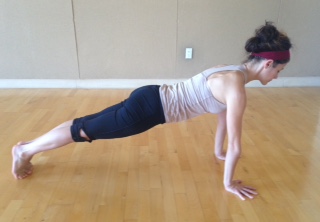
Use Plank Pose, which asks the Transverse Abdominis (TA) as well as the RA to hold the contents of your abdomen up and away from gravity. If straight arms are an issue, go to forearm height. I like holding plank for 8 to 10 seconds and repeating several times. It is easy to move into a side plank using a front, right side, front, left side sequence.
Use Camel, which is a backbend extraordinaire. It is not necessary to put your hands on your heels; Camel can be done with your palms on your mid back. Lift your chest and press your hips forward. Again, use your breath to deepen into and stretch your abdomen.
Follow with Rabbit, by gently folding forward and taking hold of your heels. Inhale, and as you exhale, open your mouth, breathing as much of your breath out as possible. Feel your TA and RA lift, hollowing out your abdomen.
End with a Seated Spinal Twist, holding the twist, focusing on a deep exhalation and the crown of your head lifting. Perform on both sides.
These postures are probably already a part of your yoga classes. Be mindful while you are performing these five postures of their inherent benefits to your trunk and abdominal area.
From Ananda Marga's yoga teachers' manual: "The entire human organism is controlled by the hormones. Asanas balance the hormonal secretions from the various glands. The twisting and bending positions of the asanas, held for specific periods of time, place continued and specific pressure on the various glands of the body, thus stimulating them and regulating their secretions."
Whispers of the Breath Diva:
In this moment I can fully exhale and feel my diaphragm. I can fully feel the wave of my breath moving through my core.